Blog
Stronger rise in new orders, partly driven by improved foreign sales
The Dutch manufacturing sector started the second half of the year on a positive note, according to the latest Nevi PMI® data. The total number of new orders increased at a faster pace, partly due to a rise in foreign sales. Production volumes continued to grow steadily as well.
When it comes to prices, both input and output price inflation increased, although they remained moderate by historical standards.
The Nevi PMI® for the Dutch manufacturing sector is a composite indicator that summarises the overall health of the sector in a single figure. It is based on five components: new orders, output, employment, supplier delivery times and stocks of purchases.
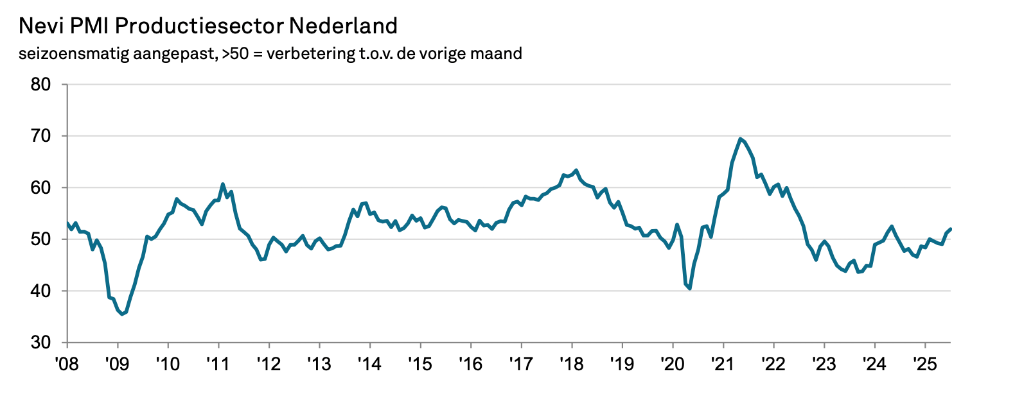
The headline index rose to 51.9 in July, remaining above the no‑change threshold of 50.0 for the second consecutive month (June: 51.2), marking the highest reading since May 2024. The stronger figure was driven by faster growth in new orders, continued job creation and a renewed rise in input inventories.
Supported in part by higher foreign sales, July saw a second consecutive increase in new orders — the strongest rise since May 2024. Panel members attributed this to new projects and a general improvement in demand.
As in every month since March, output continued to grow steadily in July.
Growth in both output and new orders was concentrated in the intermediate and investment goods subsectors, while producers of consumer goods reported declines.
Business expectations for output in the year ahead were revised slightly upward again in July. Companies continued to anticipate improved market conditions, new customers and stronger foreign demand. Expansion plans and the introduction of new products were also cited as reasons for this optimism. Overall confidence was broadly in line with the long‑term average, with the share of optimists (43%) far exceeding the share of pessimists (8%).
To meet order requirements and support growth plans, staffing levels were expanded further in July. Employment rose at the fastest pace since March 2023. At the same time, the volume of outstanding business continued to decline, extending the period of reduced backlogs to two and a half years.
Demand for materials increased in July, and purchasing activity expanded for the first time in three years. According to panel members, this rise was driven both by current production needs and by the need to rebuild inventories in anticipation of higher new‑order volumes. As a result, input inventories also increased, ending the sequence of monthly declines that had persisted since early 2023.
Meanwhile, supplier delivery times lengthened again in July, with reports of stock shortages, delayed shipments and supplier‑side disruptions.
Regarding prices, input costs for Dutch manufacturers continued to rise in July. Panel comments indicated that higher raw‑material prices were the main driver.
To pass on this increased cost pressure to customers, firms raised their selling prices again in July. Both input and output price inflation were higher than in June, although they remained low by historical standards.
Wil je een abonnement op de Nevi PMI? Lees meer