Respondents frequently reported an improvement in demand, despite subdued foreign sales and growth constraints stemming from global economic uncertainty.
September data showed a marked improvement in operating conditions in the Dutch manufacturing sector, driven by stronger increases in output, new orders and employment.
Respondents frequently reported an improvement in demand, despite subdued foreign sales and growth constraints stemming from global economic uncertainty.
Cost pressures eased in September, and the latest rise in input prices was the smallest since October 2024. However, supplier performance deteriorated at the sharpest rate in almost three years, mainly due to longer international delivery times and capacity constraints at suppliers.
The Nevi PMI® for the Dutch manufacturing sector is a composite indicator that summarises the state of the sector in a single figure. It is based on five components: new orders, output, employment, supplier delivery times and stocks of purchases.
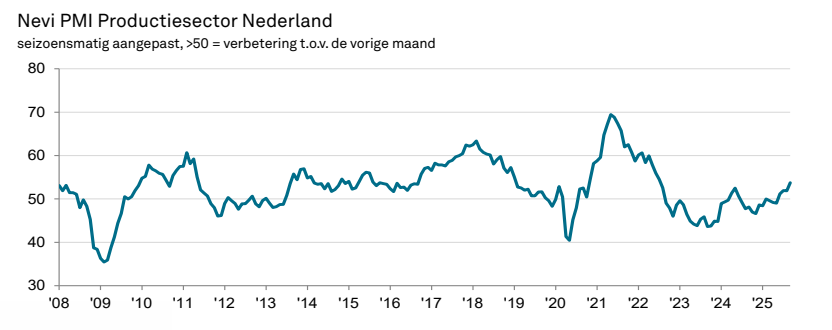
The PMI rose from 51.9 in August to 53.7 in September — the strongest increase since July 2022 — and remained above the no‑change threshold of 50.0 for the fourth consecutive month.
The rise in the headline index was further supported by a strong and accelerated increase in output at Dutch manufacturers, the fastest since May 2024. Panel members often attributed the rise in production to improving demand and the launch of new products.
Total new orders also increased, and at the fastest rate in sixteen months, with several firms reporting that customers were more willing to place orders. However, the data showed that this growth came mainly from the domestic market, as foreign sales declined in September amid reports of intense international competition. Although the drop in export sales was modest, it was the first decline in four months.
Even so, the increases in output and new orders encouraged firms to expand their workforce in September. Job creation was the strongest since December 2022.
Backlogs of work continued to decline, although the reduction was the smallest in the current period of growth. Some firms reported using existing inventories to help fulfil outstanding orders. Stocks of finished goods also fell, marking the sharpest decline since January.
Improved demand also encouraged firms to increase their purchasing activity for the second time in three months. Although the rise was modest, it was the second‑strongest since August 2022. Stocks of purchases fell again in September, but the decline was limited and much smaller than in the first half of the year.
At the end of the third quarter, Dutch manufacturers once again reported a marked deterioration in supplier performance. Panel members pointed to longer delivery times, staffing shortages at suppliers and stronger demand for materials, all of which added pressure to supply chains. The lengthening of delivery times was the greatest since October 2022.
The latest survey data showed that cost pressures eased considerably in September. Input price inflation slowed to its weakest rate since October 2024, with some firms attributing this to intense competition among suppliers. Output price inflation also eased compared with August, although it remained elevated.
Finally, Dutch manufacturers remained positive about production prospects for the coming twelve months. Firms often expected long‑term investments and the launch of new products to support further growth in output.
Would you like to subscribe to the Nevi PMI? Lees meer