A shortage of raw materials continued to put pressure on supply chains, leading to longer delivery times and increased cost pressures. Selling prices were raised more sharply this month. Business confidence regarding future output remained positive, but fell to a level below the long‑term average.
The Nevi PMI® for the Dutch manufacturing sector is a composite indicator that summarises the state of the sector in a single figure. It is based on indicators for new orders, output, employment, delivery times and stocks of purchased materials.
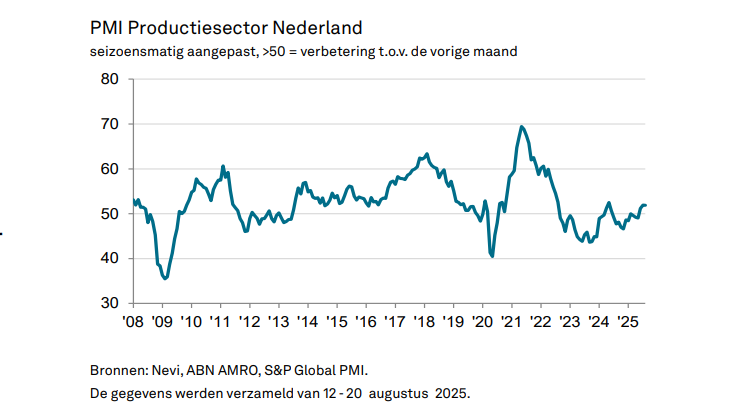
The headline PMI remained unchanged at 51.9, signalling an improvement in operating conditions for the third consecutive month. The positive contributions from the sub‑indices for output, delivery times and employment offset the smaller rise in new orders and a renewed decline in input inventories.
Total new orders increased in August for the third month in a row, with firms reporting the acquisition of new projects.
However, this increase was modest — the smallest of the three months. The near‑stagnation in foreign sales contributed to this. The rise in new export orders was minimal and stood in stark contrast to the strong increase recorded in July.
Even so, the latest data showed a substantial and stronger rise in production volumes in Dutch manufacturing, following five months of only marginal growth. In August, output growth reached its highest level in fifteen months.
This encouraged manufacturers to hire new staff in August, often on temporary contracts. Like output, employment growth was significant and the strongest since December 2022. In line with the trend seen since early 2023, firms again had sufficient capacity to reduce backlogs. The decline in outstanding business was sharp — the steepest since March.
After the growth recorded in July, firms reduced their purchasing activity in August, although the decline in the volume of inputs bought was limited. As a result, there was a renewed decrease in input inventories, with some companies indicating they were aiming to optimise stock levels. Even so, this latest reduction was modest.
On the supply side, delivery times lengthened for the third consecutive month in August. According to panel members, this was mainly due to stock shortages at suppliers. The deterioration in supplier performance was the sharpest in six months.
Material shortages also contributed to rising operating costs. With this latest increase in input prices, the current trend of higher purchasing costs has now lasted for almost a year and a half. Although inflation eased compared with July, it remained substantial. Companies raised their selling prices more sharply in August in an effort to pass on the higher cost pressures to customers. Selling price inflation was also strong, reaching its highest level in four months.
Businesses remained positive in August about output growth over the coming twelve months. This optimism was supported by new customer acquisition, plans for capacity expansion and broader growth ambitions. However, business confidence fell to its lowest level in four months and remained historically subdued.