Blog
Manufacturers continue to cut costs despite ongoing growth in new orders
Dutch producers reported a steady improvement in business conditions halfway through the final quarter of the year. Continued growth in output and new orders offset further declines in stocks of materials and employment, while conditions in the supply chain deteriorated.
The Nevi PMI® for the Dutch manufacturing sector is a composite indicator that summarises the state of the sector in a single figure. It is based on sub‑indices for new orders, output, employment, delivery times and stocks of purchased materials.
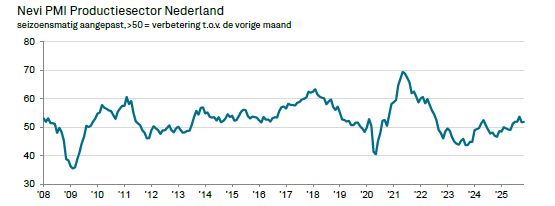
November saw a further, modest improvement in overall sector conditions, with the headline PMI remaining unchanged at 51.8. The underlying data showed only small movements across the component indices.
At subsector level, investment goods stood out as the strongest performer, recording a marked improvement in business conditions. The intermediate goods subsector also saw an improvement, while producers of consumer goods reported a deterioration.
The latest rise in output in the Dutch industrial sector was moderate and the smallest in four months, although it remained above this year’s average.
Higher output was driven by a similarly moderate increase in new orders in November. The improvement in demand had several causes, including winning tenders, new projects and intensified sales efforts. Foreign sales also rose modestly again in November, with the increase larger than in the previous month and the strongest since July.
Despite the continued rise in new orders, producers remained cautious in their hiring and purchasing activities. Overall employment fell for the second consecutive month, although only slightly. Companies reported that departing staff were not being replaced and the number of temporary workers was reduced. Some panel members noted that productivity improvements had reduced their staffing needs.
There were still clear signs of excess capacity, as the volume of outstanding business fell at the fastest rate since March.
Following the sharpest rise in purchasing activity in more than three years in October, the amount of materials purchased declined slightly in November. Some firms reported that their current stock levels were sufficient for the amount of work in progress.
Nevertheless, suppliers again failed to process orders on time in November. Supplier performance deteriorated markedly, with reports of staff and material shortages.
Stocks of purchased materials fell in November at the fastest pace in three months. There were indications that firms had drawn down existing inventories to meet production requirements, partly due to financial constraints and planned stock reductions.
Higher energy, labour and raw material costs led to a further increase in operating expenses in November. After reaching a one‑year low in October, input price inflation rose significantly in November, although it remained well below the long‑term average. Selling prices continued to rise at a moderate pace, with selling price inflation matching October’s level, which had been the lowest in twelve months.
Business expectations for output over the next twelve months were the highest since July. However, confidence remained below the long‑term average due to concerns about future demand.
Would you like to subscribe to the Nevi PMI? Lees meer