Blog
Improved business conditions in the Dutch manufacturing sector despite weak underlying demand
February saw a slight improvement in business conditions within Dutch manufacturing, marking another month of growth. Output increased at a stronger pace, and the latest decline in new orders was modest.
The Nevi PMI® for the Dutch manufacturing sector is a composite indicator that summarises the state of the sector in a single figure. It is compiled using data on new orders, output, employment, delivery times and stocks of purchased materials.
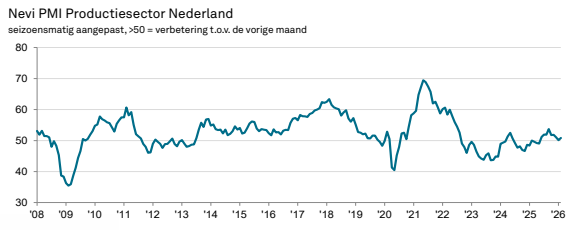
The PMI headline index rose from 50.1 in January to 50.8 in February. This latest figure indicates a modest improvement in overall sector conditions, in line with the average for 2025.
Of the five sub‑indices, output, new orders and stocks of purchased materials made positive contributions.
Demand for goods produced in the Netherlands fell again, as shown by a second consecutive decline in total new orders received. However, the latest decrease was slight and largely driven by a renewed drop in new export orders. Although the fall in foreign sales was modest, it was the sharpest in almost a year. Firms reporting fewer new orders attributed this to subdued global demand and a lack of investment.
Despite the decline in new orders, Dutch manufacturers increased their production in February. Respondents noted that they were often working on existing orders or new projects. The rise in output was the strongest in three months, though still modest by historical standards.
Manufacturers continued to focus on reducing backlogs in February, and the volume of outstanding business fell sharply. Employment increased for the third consecutive month, although job creation remained limited and was the weakest in the current period of growth.
Dutch manufacturers again opted for smaller inventories. Several firms reported efforts to reduce stock levels in response to weaker inflows of new orders. However, the declines in both input inventories and finished goods stocks were smaller than in January, with the reduction in input inventories being minimal.
To support these lower inventory levels, firms reduced their purchasing activity in February for the fourth consecutive month. This contraction was modest but the sharpest since June of last year.
Lower purchasing levels did not fully ease pressure on supply chains, and reports of delivery delays due to stock shortages persisted. Supplier performance deteriorated markedly, although the decline was the smallest in four months.
In terms of prices, operating costs for Dutch manufacturers rose significantly in February. Input price inflation was the highest in nearly a year, with firms reporting increased costs for raw materials — including metals — as well as higher wage costs.
Companies passed part of these cost increases on to their customers through higher selling prices. Output price inflation was also strong and reached its highest level in eleven months.
On a positive note, Dutch manufacturers were optimistic about production prospects for the year ahead. Confidence rose back above the long‑term average, supported by expectations of improved order inflows, upcoming product launches and marketing efforts.
Would you like to subscribe to the Nevi PMI? Lees meer