Blog
Dutch manufacturing sector largely stable at the start of 2026
Business conditions in the Dutch manufacturing sector were broadly stable at the beginning of the year. Despite signs of weak demand — largely attributed to lower domestic sales both output and employment recorded slight increases.
The Nevi PMI® for the Dutch manufacturing sector is a composite indicator that summarises the state of the sector in a single figure. It is compiled from indicators on new orders, output, employment, delivery times and stocks of purchased materials.
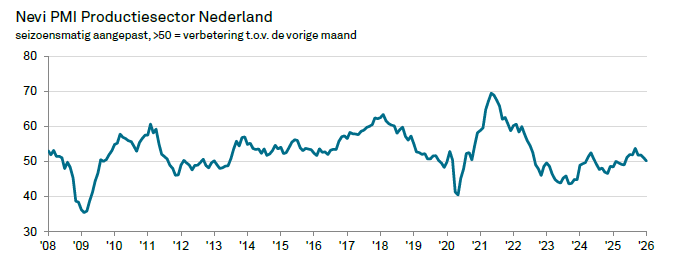
The headline index fell from 51.1 in December to 50.1 in January. This latest figure signalled a slight improvement in business conditions — the smallest in the current eight‑month period of growth. The near‑neutral reading reflected positive contributions from output, employment and delivery times, which just outweighed the negative impact of new orders and stocks of purchases.
The decline in the headline index was mainly driven by the smaller number of new orders received. This was the first decrease in eight months. Although modest, it ran counter to the historical trend of growth. Surveyed firms largely attributed the drop to weak domestic demand, as new export orders increased slightly in January.
Despite the lower inflow of orders, employment rose for the second consecutive month. Panel members often reported hiring new staff to support their growth plans, although the expansion of workforce numbers remained limited.
Greater production capacity and work on previously received orders led to an increase in output in the Dutch manufacturing sector in January. However, the rise was modest and remained below the survey average.
The combination of falling sales and higher output led to a further decline in the level of outstanding business. This marks exactly three years of decreasing backlogs. The reduction was substantial and the largest since February last year.
The limited number of new orders meant that producers purchased fewer inputs. Although modest, the decline in purchasing activity was the steepest in seven months. Higher output and lower purchasing led to a sharper reduction in stocks of purchases, with several firms noting a preference for operating with lower inventory levels. This was the largest decrease in just over a year.
Efforts to optimise inventories also resulted in a further decline in stocks of finished goods. This was the sharpest reduction in four and a half years.
However, suppliers were again often unable to deliver orders on time in January. Stock shortages, weather conditions and transport issues contributed to longer delivery times. Even so, the deterioration in supplier performance was less severe than in December.
Producers once more reported an increase in average input costs in January. Prices for metals and plastics were said to have risen, as well as labour and transport costs. Firms passed at least part of this cost pressure on to customers through higher selling prices. Input and output price inflation rose to their highest levels in ten and nine months respectively.
Looking ahead to the next twelve months, Dutch manufacturers were less optimistic than in December about an increase in output over the coming year. Business confidence fell below the long‑term average, reaching its lowest level since November 2024, with firms citing concerns about persistently weak demand.
Would you like to subscribe to the Nevi PMI? Lees meer