Blog
Strongest inflationary pressure in more than three years in the Dutch manufacturing sector in March
The Dutch manufacturing sector performed well in March, with the first increase in new orders this quarter, partly driven by rising foreign sales. Although the overall results were positive, there was also instability in supply chains due to the war in the Middle East.
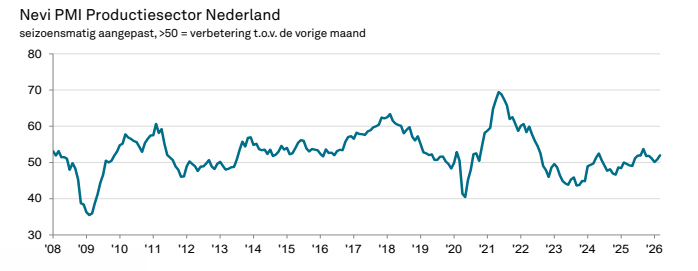
The Nevi PMI® for the Dutch manufacturing sector is a composite indicator that summarises the state of the sector in a single figure. It is based on indicators for new orders, output, employment, delivery times and stocks of purchased materials.
The headline index rose from 50.8 in February to 52.0 in March – the highest figure in six months. Of the five components of the headline index, only employment had a negative impact on the score. Importantly, the positive contribution of delivery times was not only the result of increased demand for materials, but also of supply chain disruptions caused by the war in the Middle East.
After a monthly decline in new orders since the start of this year, demand for goods produced in the Netherlands increased again in March. Companies partly attributed this improvement to uncertainty in the supply chain due to the war in the Middle East. However, the rise in total new orders was limited and aligned with a similarly modest increase in foreign sales.
The higher number of new orders led Dutch manufacturers to increase their production again in March, to the greatest extent since November last year. All three subsectors surveyed recorded a rise in output, with the investment goods subsector leading the way.
The larger inflow of orders and, in some cases, the building of buffer stocks due to supply chain disruptions in the Middle East led to the first increase in purchasing activity since October last year. However, material inventories changed very little, showing a slight decline compared with February.
Dutch manufacturers reported longer delivery times in March, particularly from Asia. This deterioration in supplier performance was significant and the largest in more than three and a half years.
Supply chain disruption was a key reason for the increased cost pressures faced by Dutch manufacturers in March. Input price inflation was substantial and rose to its highest level in forty‑one months. Panel members reported higher prices for metals, plastics, fuel, energy and wages.
The increased cost pressure prompted companies to raise their selling prices in March to protect margins. Selling price inflation was the highest in more than three years.
Despite the higher inflow of orders, companies chose not to replace departing staff and not to renew temporary contracts, resulting in a modest decline in employment. As a result, the reduction in backlogs was smaller than in February.
Dutch manufacturers were also less optimistic in March about production levels over the next twelve months. Business confidence fell below the historical average. Order volume expectations remained positive, but sentiment was dampened by concerns about the geopolitical climate.
Would you like to subscribe to the Nevi PMI? Lees